

The Future of Cooling Embedded Systems

Why Thermal Management is Now a System-Level Design Priority
The Current State of Cooling
Thermal performance is no longer confined to a single board, module, or cooling solution; it influences the behavior and reliability of every subsystem within a defense platform. As power densities increase and architectures become more tightly integrated, heat becomes a shared constraint that shapes decisions across electronics, mechanical design, and system architecture.
Traditional Cooling Approaches Are Falling Short
Defense electronics have undergone a dramatic transformation over the past decade. Systems that once relied on relatively modest processing capabilities are now expected to support artificial intelligence, real-time sensor fusion, advanced radar processing, electronic warfare, autonomous operations, and high-speed communications all within increasingly compact platforms. While these advancements deliver significant operational advantages, they also generate substantially more heat.
While heat has always originated at the component level, today’s embedded architectures generate more processing power, higher component densities, and faster interconnects within the same footprint. As a result, processors, GPUs, FPGAs, networking devices, power converters, and high-speed interfaces collectively contribute to a much more complex thermal environment, requiring cooling strategies that address the entire system rather than isolated components. As these systems become smaller, more powerful, and increasingly connected, the heat generated within compact enclosures can quickly compromise performance, reliability, and longevity.
Future-Proof with Early Thermal Planning
Cooling capabilities should be a critical design consideration during the early stages of system development to allow high-performance embedded systems to execute successfully in demanding environments.
When addressed early on, thermal management becomes an enabler rather than a limitation. Engineers can integrate compute density, mechanical packaging, and cooling strategies to ensure that systems not only meet current performance requirements but also enable future scalability.
Early planning doesn’t just maintain cooling performance; it creates thermal headroom. This extra margin enables the ability to add new sensors to defense systems, support higher-performance processors, and adapt to evolving mission needs and future capabilities.
What Can Open Architectures Teach Us About Cooling
As the embedded electronic industry continues to embrace modular open architectures, thermal management must evolve alongside the electronics it supports. The adoption of open standards has fundamentally changed the way defense electronics are designed, integrated, and upgraded. Standards such as VPX, OpenVPX, and SOSA were developed to address the longstanding difficulty of integrating hardware from different suppliers into a common system architecture. By defining standardized electrical and mechanical interfaces, these frameworks have enabled greater interoperability and reduced integration risk, creating a more adaptable future of technology across defense platforms. Thermal management is moving in a similar direction.
Just as standardized electrical and mechanical interfaces allow modules from different suppliers to work together, standardized thermal interfaces and cooling methodologies help ensure that heat can be transferred and managed consistently across the system. Standardized cooling strategies ensure alignment with the broader goals of modern electronic architectures: predictable interfaces, repeatable integration, and adaptable future technology insertion. VITA addresses these standard thermal interfaces and cooling methodologies in VITA 48.1, 48.2, 48.4, 48.5 and 48.8 for VPX architectures and is currently working on the new cooling technology approaches for VITA 100 (Next Gen VPX) architectures.
How VITA 100 Is Driving the Need for Advanced Thermal Management
Enhanced interoperability and higher pin counts directly influence thermal management approaches. For example, the VITA 100 (Next Gen VPX) standard will double electrical connections and quadruple link bandwidth, driving increased compute densities that will break traditional cooling limits. To handle these higher thermal loads, system designers will need to transition to advanced cooling methodologies like Air-Flow-Through (AFT), Liquid-Flow-Through (LFT), or hybrid systems combining liquid chassis coldplates with conduction-cooled modules. LCR can address these future cooling challenges through thermal assessments and Computational Fluid Dynamics (CFD) tools to deliver the proper thermal management solution to our customers.
At LCR, we understand the importance of embedded cooling, as we are heavily involved in the development of the VITA 100 mechanical suite of standards, including VITA 100.12, which is defining the baseline approaches and mechanical requirements for AFT cooling. The VITA 100.12 working group is working to develop a formal standard defining the requirements and interfaces for AFT plug-in modules, chassis, and backplanes. Once completed, this standard will define 3U, 4U, and 6U form factors to ensure mechanical compatibility, thermal performance, and interoperability within VITA 100-compliant systems.
Thermal Management is Not One-Size-Fits-All
A standardized cooling solution is not always practical because thermal management requirements vary significantly across electronic systems and rugged environments. System designers must account for many thermal factors, including power dissipation, ambient temperatures, altitude, solar loading, cooling mediums, thermal resistance, size, and weight. Operational requirements further complicate the design process, as electronics deployed on aircraft, naval vessels, and ground vehicles are each exposed to distinct environmental conditions and mission profiles. When a standardized cooling solution can’t be used, LCR will leverage a custom or hybrid thermal solution from its extensive design portfolio to establish a known technical baseline for characterizing the thermal performance of the product. This baseline streamlines the development pipeline, effectively shortening design cycles and validation timelines for new design programs.
While air and conduction cooling have long been the primary methods for managing heat in electronic enclosures, recent advancements in liquid cooling methodologies have expanded the range of thermal management options. This approach offers greater cooling efficiency and can be customized to meet the unique demands of modern embedded computing applications. Systems designers must consider using a wider variety of standardized cooling approaches and sometimes incorporating several different cooling techniques in the same system to achieve size and performance goals.
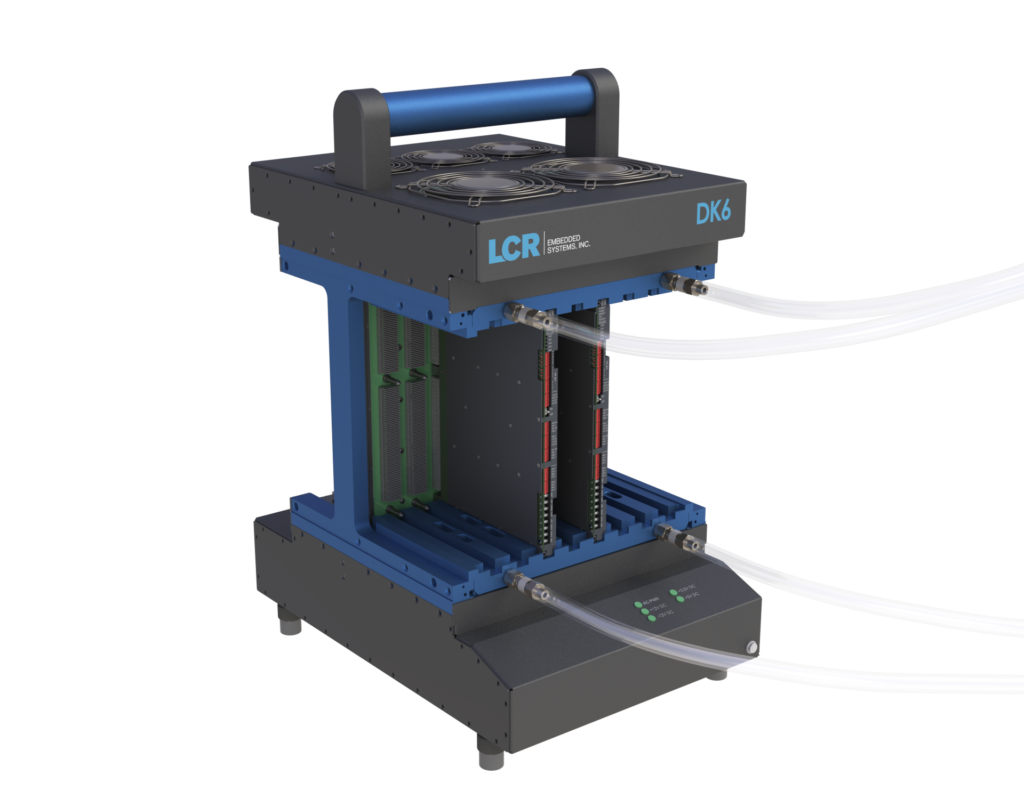
At LCR, we leverage proven, standardized cooling methodologies as the basis for application-specific solutions. If standard air or conduction cooling methods prove insufficient for heat loads, we can engineer a hybrid thermal management strategy. For example, if high-performance electronics require liquid cooling but the overall platform lacks an integrated fluid infrastructure, LCR can integrate a self-contained, closed-loop liquid cooling system directly at the chassis level. This internal sub-system utilizes a pump, heat exchanger, reservoir, and coolant to deliver liquid-to-air and liquid-to-conduction heat transfer without requiring external plumbing and infrastructure to the chassis.
How to Approach the Future of Embedded Cooling
As the electronics industry continues to rapidly evolve toward smaller form factors and increased thermal densities, remaining at the forefront of innovation with new thermal management strategies is crucial for success. Liquid cooled electronic packaging solutions from LCR address the thermal management challenges in systems that support advanced signal processing, compute-intensive workloads and the growing use of AI algorithms and machine learning models in embedded systems.
Popular Resources