

Cooling as an Afterthought: Why Thermal Design Needs to Start Early

The rise of miniaturization of embedded electronics and escalating heat fluxes across modern defense systems has intensified the demand for advanced thermal management. AI and machine learning, advanced sensor processing, autonomous capabilities, high-speed networking, signal processing, and other demanding applications are pushing embedded platforms toward higher power densities. The result is a fundamental shift in the role of thermal management for embedded systems.
Cooling capabilities have become a critical design consideration during the early stages of system development due to increased processing performance, smaller package and system footprints, and the requirement to operate in the harshest environments.
Reliability Starts with Early Thermal Architecture
When addressed early on, thermal management becomes an enabler rather than a limitation affecting how a system is built, maintained, serviced in the field and upgraded. Decisions about component placement, board layout, cable routing, connector location, and even processor selection all influence how effectively heat can be removed. Thermal design directly affects performance stability and long-term reliability. In embedded systems, overheating increases the likelihood of breakdown and premature failure. Addressing proper cooling architecture early on can help create a reliable thermal headroom for electronic systems in demanding environments.
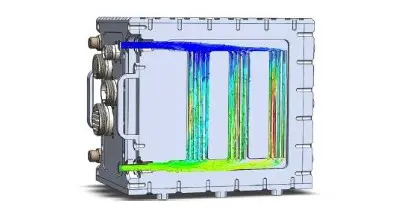
While air and conduction cooling have long been the primary methods for managing heat in electronic enclosures, recent advancements in liquid cooling methodologies have expanded the range of thermal management options. This approach offers greater cooling efficiency and can be customized to meet the unique demands of modern embedded computing applications. With each method of cooling comes fans, filters, thermal interfaces, pumps, plumbing, and other cooling hardware that can all become considerations over the operational life of a system. Their accessibility and the amount of system disassembly required to service them can have a direct impact on field service time and complexity. A well-designed cooling architecture can contribute to reliability while preserving accessibility, serviceability, and future flexibility of a system.
Early Thermal Decisions Preserve Design Freedom for Embedded Systems
Early thermal planning creates options; late thermal planning creates constraints. When engineers address key cooling architecture questions early on, such as anticipated heat loads and size, weight, and power (SWaP) requirements, it allows for more flexibility in how the system is built. Air cooling, conduction cooling, liquid cooling, or hybrid approaches can be considered based on the application’s actual requirements rather than on what happens to fit into an architecture that was designed without thermal considerations. Engineers are increasingly balancing competing requirements around size, weight, power, performance, environmental durability, and maintainability. Cooling needs to fit within that same trade space.
Addressing thermal management in the early stages of system development creates an opportunity to design around the system’s future requirements, rather than simply its initial configuration. If an architecture is expected to support processor or payload upgrades, understanding the available thermal capacity early can help determine how much headroom should be built into the design. Efficient cooling architectures prevent the need to protect against overheating with reduced cycle rates and computing power by ensuring that your system can maintain its performance at high ambient temperatures.
Late Thermal Decisions Create System-Level Compromises
In embedded system design, every architectural decision matters. Addressing cooling architecture too late can lead to compromises throughout a system including:
- Chassis layout: Component placement becomes dictated by thermal survival, forcing non-standard slot pitches, awkward physical envelope expansions, and inefficient placements to accommodate bulky heat sinks or custom coldplates.
- Payload selection: High-performance compute modules must be downgraded or power-capped to stay within strict thermal limits, eliminating optimal COTS hardware options and restricting slot power allocation.
- Airflow path: Air routing becomes tortuous and restricted, requiring oversized, noisy fan arrays to overcome high static pressure while creating dead zones that trap localized heat.
Today’s Thermal Limits Can Become Tomorrow’s Upgrade Limits
Defense electronics have undergone a dramatic transformation over the past decade and are continuing to grow at a rapid pace, generating more processing power, higher component densities, and faster interconnects all within the same footprint. As a result, processors, GPUs, FPGAs, networking devices, power converters, and high-speed interfaces collectively contribute to a much more complex thermal environment, requiring cooling strategies that address the entire system rather than isolated components. Higher performance requirements lead to higher power density needs, resulting in an overall demand on a system’s thermal architecture. Establishing a thermal margin is critical for future payload upgrades.
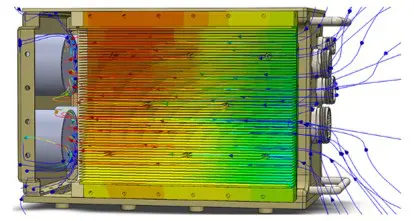
When a chassis or enclosure is designed to operate at its maximum thermal dissipation capability from day one, the system can become constrained by its cooling capacity rather than its available physical space or processing capability. Future processor and FPGA upgrades, higher-density AI or multi-die devices, additional payload cards, and higher-bandwidth RF or optical interfaces can all increase thermal loads beyond what the original cooling architecture can support.
This can limit the ability to populate spare slots, integrate higher-performance hardware, or increase system bandwidth without redesigning the cooling solution. In some cases, the added heat can also cause localized hotspots or thermal throttling, reducing the performance gains of an otherwise capable upgrade.
As embedded systems become more powerful and power-dense, thermal margin should therefore be treated as a measure of scalability as well as reliability. Engineers routinely plan for additional memory, processing capability, power, bandwidth, and I/O; thermal capacity deserves the same consideration. Building in sufficient margin from the outset allows platforms to accommodate evolving technologies and mission requirements without making the thermal architecture the limiting factor.
The Costs You Don’t See
The cost of a cooling solution is usually straightforward to identify fans, heatsinks, cold plates, pumps, heat exchangers, or other thermal-management hardware. What is harder to see is the cost that emerges when the cooling architecture is left to be determined until the rest of the system has already been defined. A cooling architecture designed only to meet today’s requirements can create hidden lifecycle costs through limited upgrades, underutilized hardware, redesigns, and qualification failures.
The cooling system may be the visible cost but the constraints it creates can become a much larger one if not considered in the early stages of system development.
One of the biggest costs is lost upgrade flexibility. When a system operates at its thermal limit, a future higher-wattage CPU or FPGA may no longer be a simple drop-in upgrade. Additional processing hardware or payload cards may also require unused slots to remain empty to prevent thermal concentrations. Even when higher-performance components can be installed, insufficient cooling may force them to throttle, leaving expensive silicon operating below its potential.
The cost of inadequate thermal planning can increase further when problems are discovered during qualification. Late-stage thermal failures may require custom cooling hardware, chassis modifications, additional NRE, or scrapped components rather than straightforward design changes. Repeating environmental or thermal testing can add significant laboratory and engineering costs while delaying deployment.
The cooling hardware may represent a relatively small portion of the initial system cost, but running out of thermal headroom can create much larger lifecycle expenses. Designing sufficient thermal capacity early helps preserve upgrade opportunities, reduce redesign risk, and avoid costly qualification failures
Thermal Architecture as a Foundation for Future Performance
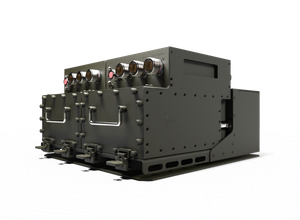
As embedded defense systems continue to become smaller, more powerful, and more computationally demanding, thermal management can no longer be treated as a final packaging consideration. The question is no longer how to remove the heat, it is how the thermal architecture can support everything the system is expected to do throughout its lifecycle. Thermal headroom provides room for higher-performance payloads, evolving processing requirements, changing mission demands, and future upgrades. It gives the architecture an opportunity to evolve rather than forcing engineers to redesign it every time performance requirements increase.
The role of thermal management is evolving from simply removing heat to enabling what comes next. LCR brings thermal design into the broader embedded system architecture, helping engineers evaluate electronics cooling strategies alongside performance, SWaP, reliability, serviceability, and future growth. The objective is not simply to keep today’s system within its thermal limits, but to create an architecture with the headroom to support tomorrow’s requirements. For today’s embedded systems, thermal capacity should be considered alongside processing power, memory, bandwidth, I/O, and electrical power as a fundamental system resource.
Popular Resources

